Skip to content

Nutrition label game: the aisle

Turn the packages, weigh the samples and pin the back-label evidence for each market order.

A free nutrition label game: 5 levels and an endless one. No sign-up, no download.

Play level 1

4 minutes. Every step explained. No sign-up.

Try one right here.

Which sample has more added sugars?

Compare the amounts for the sample weights, not the figures per serving.

Nimbrufruit bitesNet wt 60 g
A · Nimbru

Nutrition Facts

Serving size 20 g

Added sugars 1 g

50 g sample

Orvulufruit bitesNet wt 160 g
B · Orvulu

Nutrition Facts

Serving size 40 g

Added sugars 1 g

60 g sample

Levels

5 levels. Each adds one kind of trap and keeps the old ones. Start anywhere; the marked one is next for you.

What you learn to see

  • Turn the packs

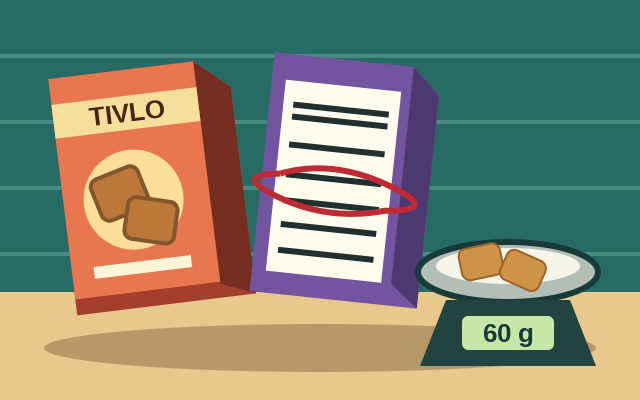
    The illustrated fronts make numerical claims. The backs hold serving details and nutrition facts.

  • Work the scale

    Fill two portion trays to the actual weights on your ticket. Pin each label's relevant row.

  • Check the claim

    Compare the totals and check whether a front figure is supported by its own stated basis.

Got a real one in front of you?

Examples that explain themselves, calculators and lists.

Read a food label in this order

Five things to record before comparing two samples.

  1. What is the serving size?Most figures on the back refer to one serving, not the whole package.
  2. How many servings are in the container?You may need to multiply when comparing the whole package.
  3. What portion is actually being compared?Divide that weight by the serving weight, then multiply the amount shown for one serving.
  4. Which nutrient and unit does the task name?Grams and milligrams are not the same; added sugars and total sugars are different rows.
  5. What is the basis of the front claim?A per-serving figure may be correct even when the whole pack has several times that amount.

The two sides of a package

A nutrition label game lets you handle two invented food packs. One face attracts attention; the Nutrition Facts panel is on the other. Every market ticket tells you which samples to put on the balance and which nutrient to compare.

The sample changes the comparison

The labels print figures for one serving. The requested samples can be smaller or larger. When one pack has a 30 g serving and another has a 40 g serving, the printed numbers alone cannot answer a question about different portion weights.

An honest front can still distract

The later tickets ask whether a numerical claim matches the back on its own terms. Some do and some do not. The comparison of actual sample amounts is a separate judgment. This game tests arithmetic and careful reading, not whether a food is good or bad.
Nutrition label aisle: questions people ask

How do I compare two food labels?

Find the serving size, then work out the amount of the requested nutrient for the sample being compared. Use the same unit and nutrient for both packs.

Does serving size mean the whole pack?

Not necessarily. The number of servings in the container is printed near the top. Some labels also have a whole-package column.

What does the percent Daily Value mean?

It gives the share of a reference Daily Value represented by a serving. Not every nutrient has a percentage printed.

Are the products and quantities real?

No. The brands and practice labels are invented for this game. The tasks compare fictional samples and are not personal nutrition advice.

Where this comes from

Last changed . Rules change, and states add their own: check the source before you act on one. Found a mistake? How we check, and how to tell us.

Try something else

More like this: consumer math games, critical thinking games, life skills games.

Illustrated packages and practice labels are fictional, not regulatory templates. The sample weights are math exercises, not suggested portions or health advice.