What a logical fallacy is
A logical fallacy is an error in reasoning: the reason that is given does not support the claim. The claim can still be true. Somebody who says “this bridge is safe, my favorite singer told me so” may be right about the bridge.
So the name alone ends nothing. “That's a straw man!” is not an answer. Saying again what was really said is one. Whoever calls something a fallacy has to show it.
How to play
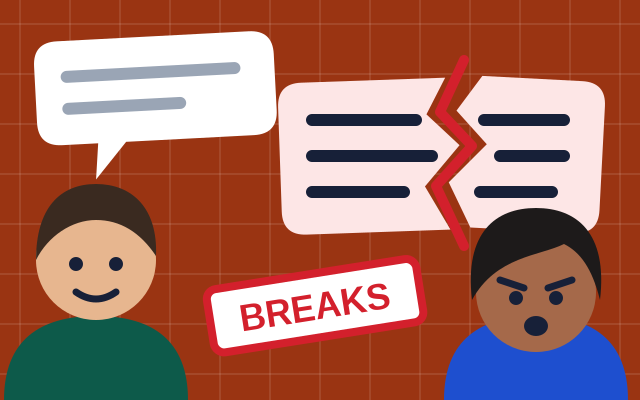
It is a critical thinking game without flashcards. You sit at the table. Four people talk about the dog on the couch, the dishes, a bike lane, an air fryer. Most of what they say is fine: facts, sums, wishes. One line breaks. Press it, and it cracks. Then pick the stamp with its name. After each one you read what was wrong, and what would have made it fair.
There are more than two hundred arguments that break, under 28 names, and dozens that hold. Everything you need stands on the screen, and it is never about parties, religion or real people. Where we know a sentence could fairly be given two names, only one of them is offered.
When a fallacy is none
Many lists stop at the names. But the same move can be bad in one place and good in the next. The sixth level is about nothing else.
- A doctor who has seen the knee is good evidence about the knee. A doctor on TV who praises a car is not.
- A chain of steps is fine when each link has a reason. It is a slippery slope when the steps are only announced.
- One case cannot show how often something happens. It is enough to show that “never” is wrong.
- Splitting the difference is fine for wishes. It is no way to find out a fact.
In a class or at home
A level takes four to six minutes, in a browser, without an account. Each run deals other arguments, so two people at two screens have something to compare. The quiz can be printed with its answers, and the list has a short drill for each name.