Nutrition label worksheet and quiz
Nutrition label worksheet and quiz for comparing actual portions. Solve a food label problem now, print six practice tickets with answers, or play the aisle game.
Which sample has more total sugars?
Compare the amounts for the sample weights, not the figures per serving.
Nutrition Facts
Serving size 50 g
Total sugars 5 g
50 g sample
Nutrition Facts
Serving size 30 g
Total sugars 2 g
60 g sample
Illustrated packages and practice labels are fictional, not regulatory templates. The sample weights are math exercises, not suggested portions or health advice.
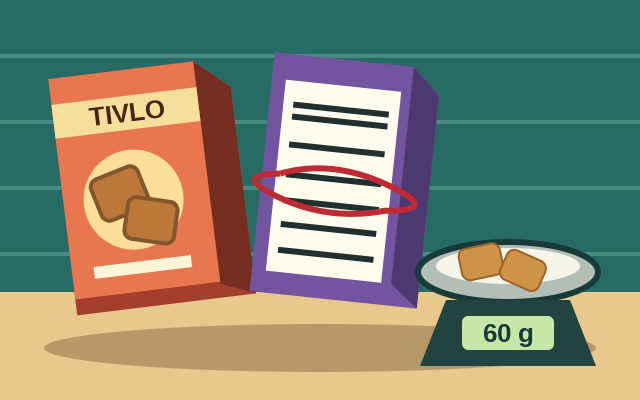
Now find the traps yourself
Nutrition label game: Turn the packages, weigh the samples and pin the back-label evidence for each market order.
Read and compare: a worked example
Pack A has 3 g dietary fiber per 30 g serving. Pack B has 5 g dietary fiber per 40 g serving. The display order asks for 60 g from A and 40 g from B.
B: 40 ÷ 40 = 1 serving; 5 × 1 = 5 g dietary fiber.
Answer: A has more dietary fiber in this particular sample.
The number printed for a serving can be true while the larger actual sample contains a different amount. Serving size is not a recommendation. This is a classroom arithmetic exercise.
Printable nutrition label worksheet
For each fictional pair, write the nutrient amount for sample A and sample B. Circle A, B or equal for the sample with more of the named nutrient. Some tickets ask for whole packs; some ask you to check a front claim as well.
1. Compare dietary fiber.
Label Pack A Pack B Serving size 20 g 60 g Servings per container 4 4 Dietary fiber per serving 3 g 4 g Order 40 g sample 60 g sample Sample total ________ ________ More: A / B / Equal
2. Compare dietary fiber.
Label Pack A Pack B Serving size 40 g 20 g Servings per container 3 3 Dietary fiber per serving 4 g 4 g Order Entire pack Entire pack Sample total ________ ________ More: A / B / Equal
3. Compare dietary fiber.
Label Pack A Pack B Serving size 50 g 20 g Servings per container 3 4 Dietary fiber per serving 3 g 3 g Order 25 g sample 20 g sample Sample total ________ ________ More: A / B / Equal
4. Compare dietary fiber.
Label Pack A Pack B Serving size 50 g 40 g Servings per container 4 4 Dietary fiber per serving 5 g 2 g Order 100 g sample 100 g sample Sample total ________ ________ More: A / B / Equal
5. Compare sodium.
Label Pack A Pack B Serving size 40 g 20 g Servings per container 5 4 Sodium per serving 220 mg 80 mg Order 40 g sample 40 g sample Sample total ________ ________ More: A / B / Equal
Pack B's front: “320 mg sodium per pack”. Does it match the label? Yes / No
6. Compare total sugars.
Label Pack A Pack B Serving size 50 g 40 g Servings per container 5 3 Total sugars per serving 6 g 4 g Order 50 g sample 80 g sample Sample total ________ ________ More: A / B / Equal
Pack A's front: “30 g total sugars per pack”. Does it match the label? Yes / No
Answer key and working
- A: 3 × 2 = 6 g. B: 4 × 1 = 4 g. Pack A.
- A: 4 × 3 = 12 g. B: 4 × 3 = 12 g. Equal.
- A: 3 × 0.5 = 1.5 g. B: 3 × 1 = 3 g. Pack B.
- A: 5 × 2 = 10 g. B: 2 × 2.5 = 5 g. Pack A.
- A: 220 × 1 = 220 mg. B: 80 × 2 = 160 mg. Pack A. Claim: yes; the matching value is 320 mg.
- A: 6 × 1 = 6 g. B: 4 × 2 = 8 g. Pack B. Claim: yes; the matching value is 30 g.
Three checks before comparing
- Check the serving size and the serving count. A container can have more than one serving.
- Use the same nutrient and unit in both calculations. Added sugars are part of total sugars, not an extra amount to add to them.
- Read the wording of a front claim. Compare a claim about a whole pack with the whole-pack figure, or with its own labeled serving if it states that basis.
The nutrition label quiz above generates new fictional problems. Use the printable sheet for independent work and the full game to practice turning illustrated packages and weighing the requested portions.
Questions people ask
How do I work out the amount in a sample?
Divide the sample weight by the serving weight, then multiply the per-serving amount by the result. A 60 g sample from a 30 g serving has twice the printed amount.
Are added sugars and total sugars the same?
No. Total sugars includes added sugars and sugars naturally present in the food. Use the row named in the question.
Is this worksheet printable?
Yes. The six paper problems use a fixed set of numbers. The answer key below them includes the working, and the print button prints the worksheet.
Are these portions recommendations?
No. The portions are example weights for arithmetic. The FDA explains that serving size on a label is not a recommendation of how much to eat.
Where this comes from
- FDA: How to understand and use the Nutrition Facts label
- FDA: Serving size on the Nutrition Facts label
Last changed . Rules change, and states add their own: check the source before you act on one. Found a mistake? How we check, and how to tell us.
Go on
See also life skills games and consumer math games and critical thinking games.