Credit card statement example: how to read it
Credit card statement example, with every section explained: see how to read a credit card statement, what the dates mean, and why the posted balance can differ from later activity. Tap the annotations and try the October balance check.
Read the October close
Tap a section heading to fold or reveal its note.
Monthly credit card statement
Oct 1–31, 2026 · Closed Oct 31 · Due Nov 25
Start with the previous balance, add purchases, fees and interest, and subtract payments and credits posted in the period. The new balance is the result at the close.
Illustrative minimum payment math
At $25.00 each month with no new charges or interest, $180.00 takes eight payments (seven of $25.00, one of $5.00).
Late payment information
This invented example has no late fee. Real terms can differ; the issuer's notice describes any applicable charge or rate change.
The due date and minimum payment are separate from the total ending balance. This sample is not a payment instruction.
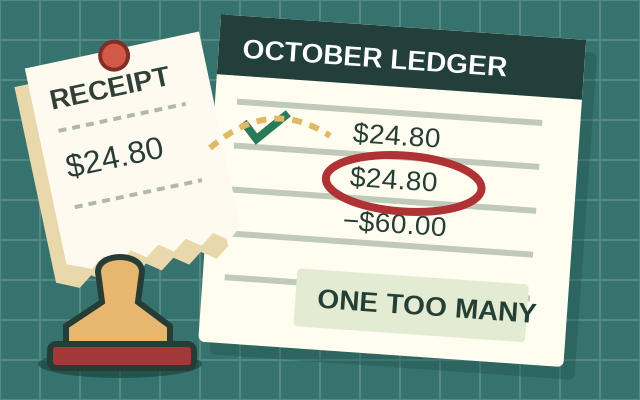
A transaction date is not always its posting date. These two book purchases are distinct even though the amounts match: R1741 and R1742 have separate dates and receipts.
The statement separates fees and interest from purchases. Year-to-date amounts show the accumulated fees and interest for the year.
No rate or account term changes in this sample. Billing questions and errors use the issuer's separate contact instructions; see the official CFPB guide below.
The annual percentage rate (APR) describes an annual rate for borrowing. Interest calculations and account notices show the terms applying to the statement; this simplified 0% example isolates the arithmetic.
6 · Outside the statement
Later activity, shown separately: an order for $15.00 is pending at the end of Oct 31. A return dated Oct 30 for $8.20 posts Nov 2.
Returned Oct 30 · Posted Nov 2
Which close includes the posted refund?
Fictional statements and receipts for reading practice only. No real card data, payment instruction or determination of a billing dispute.
Now find the traps yourself
Credit card statement game: Pin receipts to the October ledger, catch charges listed twice, sort late refunds and rebuild the closing balance.
How to read a credit card statement in order
- Find the start and end dates. Use the previous statement to check the opening balance.
- Compare posted items with receipts and payment or refund confirmations. The same dollar amount can belong to separate records.
- Rebuild the new balance. In this sample: $120.00 +$197.00 −$120.00 −$17.00 = $180.00. No fees or interest are charged in this example.
- Keep later activity separate. A current account balance can change after a statement closes.
- Read the minimum payment and due date, fees, rates and notices separately. If a line looks wrong, the CFPB explains what records and information a billing-error notice includes.
This is a fictional learning example, not a complete legal form or a real issuer's terms.
Questions people ask
What is the statement balance?
The total outstanding at the end of that billing period. Newer account activity is separate from that closed statement.
Is the minimum payment the same as the new balance?
No. The statement shows both the full new balance and a separate minimum amount with its due date.
Why might a refund not be on this statement?
A credit can post after the billing period ends. Compare the date on the posting record with the end of the statement period.
What if I cannot identify a charge?
The transaction list and supporting records can help identify it. The CFPB explains the process for asking the issuer to investigate a billing error.
Where this comes from
- NCUA — Understand your credit card statement
- CFPB — Understanding credit card statements (poster)
- CFPB — Credit card contract definitions
- CFPB — Analyzing credit card statements (student worksheet)
- Regulation Z — § 1026.7 Periodic statement
- CFPB — How to fix mistakes in your credit card bill
Last changed . Rules change, and states add their own: check the source before you act on one. Found a mistake? How we check, and how to tell us.
Go on
See also financial literacy games and life skills games and consumer math games.