Skip to content

Insurance declarations page: a home and an auto example

The insurance declarations page is the front page of a policy: what is covered, the limits, the deductibles. Press any line of this example to read it.

Press any line to read what it means.

Larkmoor Mutual
Homeowners policy

Declarations page

Policy 4471-20 · June 1, 2026

Who, where, when

Section I, property

Section II, liability

Deductibles and how losses are paid

Endorsements

Price

This policy does not include flood insurance.

The homeowners page, line by line
Named insured, Nora Whitlock
The people the policy is for. A claim check is made out to them, and for the house often to the lender too.
Insured location, 418 Alder Lane
The house that is insured. If something about it is wrong, such as the age of the roof, tell the company before there is a claim.
Policy period, 6/1/2026 to 6/1/2027
The time in which a loss has to happen. For a claim you need the page of the period in which it happened, not the newest one.
Mortgage company, Prairie Elm
The bank that lent the money for the house. Lenders usually require that they are named, and then their name is on the check for repairs.
A Dwelling, $300,000
The most the policy pays for the house itself. It is not the market price of the house, which includes the land.
B Other structures, $30,000
Things on the property that are not attached to the house: a fence, a shed, a detached garage. Often 10% of Coverage A.
C Personal property, $150,000
Furniture, clothes, electronics. This page says it covers them against theft away from home too, as many policies do. Inside it there are special limits, for jewelry, guns or coins for example. They are in the policy, not here.
D Loss of use, $60,000
The extra cost of living somewhere else while a covered loss is repaired: hotel, meals above the usual. Some policies also limit the time.
E Personal liability, $300,000
Pays when you are responsible for somebody's injury or for damage to their things, up to this limit. It has no deductible.
F Medical payments to others, $1,000
Doctor's bills of a guest who gets hurt at your home, whoever's fault it was. Not for people who live there.
Deductible, all other perils, $1,000
What you pay yourself for each claim when wind or hail did not cause it: fire, theft, a burst pipe.
Deductible, wind and hail, $3,000
A percent of the insured amount, not of the damage: 1% of $300,000 is $3,000, also for a small hole in the roof.
Dwelling and personal property, Replacement cost
Paid in the end without taking off depreciation, up to the limit, often in two checks. If a page does not say replacement cost, the policy likely pays actual cash value.
Roof surfaces, Actual cash value
The roof alone is paid by its age here. It is in the list, and it is easy to miss: a 20-year-old roof can be worth a small part of a new one.
Water backup of sewers and drains, $10,000
Many home policies exclude water that comes up through sewers and drains. This endorsement adds it back, up to $10,000.
Scheduled item: wedding ring, $4,200
Scheduled means listed by itself, with its own amount, instead of falling under the special limit for jewelry.
Ordinance or law, $30,000
Building codes change. Without ordinance or law coverage, a policy may pay little or nothing of the extra cost of meeting today's code. This endorsement pays it, up to its limit.
Premium for the period, $1,842
What the policy costs for the period. A higher deductible makes it cheaper, and a claim dearer.

Which line pays?

Case 1 of 10, home policy

0 right

A storm throws a tree on your fence.

The claims, insurers and policies are made up, and real policies differ. This is not advice about your own claim.
Now find the traps yourself

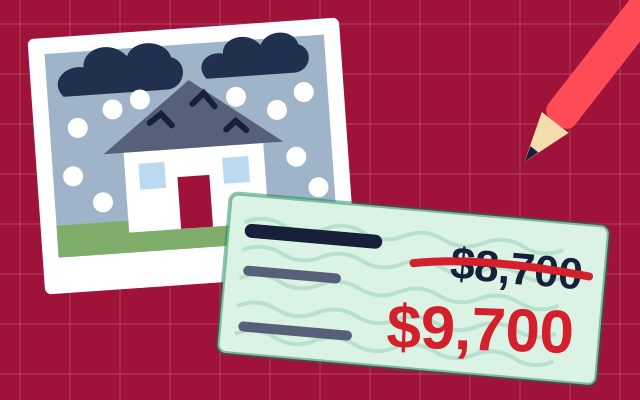
Insurance claim game: The insurance claim is settled, says the letter. The declarations page says something else. Find the lines that do not agree.

Play

What is a declarations page?

The front of an insurance policy. It names the people, the house or the cars, the period, the coverages with their limits, the deductibles, the endorsements and the price: the part of the policy that is about you.

It is a summary. What is excluded, and what you have to do after a loss, is in the policy behind it.

How to read one in five steps

  1. The policy period. Was the loss inside it? For an older loss, ask for the older page.
  2. The limits. Each coverage has its own, and one cannot be used for another.
  3. The deductibles. There may be several. A percent is taken of the insured amount, so write the dollars next to it.
  4. How losses are paid: replacement cost or actual cash value. If it does not say replacement cost, it is likely actual cash value. Look for a separate line for the roof.
  5. The endorsements, often near the end. They add things, take things out and raise limits.

Homeowners and auto, side by side

  • Homeowners pages go by letters: A the house, B other structures, C belongings, D living somewhere else, E liability, F medical payments. In Wisconsin, for one, B is usually 10% of A, C usually 50%, and D up to 20%.
  • Auto pages go by what happened and to whom: liability for others, collision and comprehensive for your own car, and extras such as rental and towing.
  • Flood damage to a house is on neither page. For the car it is one of the things that comprehensive can pay for.

Questions people ask

What is an insurance declarations page?

The front part of a policy that sums it up: who is insured, the house or the cars, the policy period, the coverages with their limits, the deductibles, the endorsements and the premium. Many people say dec page.

Where do I find mine?

In the front of the policy, and it usually comes again with each renewal. If you cannot find it, ask the company or the agent for a copy, and for the year in which the loss happened.

Is everything I need on it?

No. It is a summary. Exclusions, special limits and what you have to do after a loss are in the policy itself, and endorsements can change any of it.

What are the limits?

The most the company pays for a covered loss, for each coverage. Inside them there can be smaller ones: special limits for jewelry, guns, coins and the like. And collision and comprehensive on a car have no dollar limit; they pay up to the car's actual cash value.

More about insurance claim