Electricity bill example: read and change the cost
This electricity bill example shows how to read an electric bill. Compare two periods and change the dishwasher's start time to see exactly what the sample charges.
Move the jobs
Choose only from the permitted starts for each job. Same day repeated for 30 days.
Hourly load readings
| Hour | Original kWh | Plan kWh |
|---|---|---|
| 00:00 | 0.5 | 0.5 |
| 01:00 | 0.5 | 0.5 |
| 02:00 | 0.5 | 0.5 |
| 03:00 | 0.5 | 0.5 |
| 04:00 | 0.5 | 0.5 |
| 05:00 | 0.5 | 0.5 |
| 06:00 | 0.5 | 0.5 |
| 07:00 | 0.5 | 0.5 |
| 08:00 | 0.5 | 0.5 |
| 09:00 | 0.5 | 0.5 |
| 10:00 | 0.5 | 0.5 |
| 11:00 | 0.5 | 0.5 |
| 12:00 | 0.5 | 0.5 |
| 13:00 | 0.5 | 0.5 |
| 14:00 | 0.5 | 0.5 |
| 15:00 | 0.5 | 0.5 |
| 16:00 | 0.5 | 0.5 |
| 17:00 | 1.5 | 1.5 |
| 18:00 | 3.5 | 3.5 |
| 19:00 | 0.5 | 0.5 |
| 20:00 | 0.5 | 0.5 |
| 21:00 | 0.5 | 0.5 |
| 22:00 | 0.5 | 0.5 |
| 23:00 | 0.5 | 0.5 |
These loads cannot be moved.
Original 17:00
Pick a start time to recalculate the plan.
Period 1 used 480 kWh · Period 2 used 480 kWh
Bill comparison
Two actual periods and a what-if projection. All charges shown; no taxes or extras in this tariff.
| 30 days | Period 1 | Period 2 | Plan |
|---|---|---|---|
| Used (kWh) | 480 | 480 | 480 |
| Off-peak kWh | 360 | 300 | 300 |
| × $0.16 | $57.60 | $48.00 | $48.00 |
| Peak kWh | 120 | 180 | 180 |
| × $0.36 | $43.20 | $64.80 | $64.80 |
| Fixed fee | $14.00 | $14.00 | $14.00 |
| Total | $114.80 | $126.80 | $126.80 |
Why the actual bill rose
Extra energy at the low rate: $0.00
Extra peak premium: $12.00
Fixed fee change: $0.00
Period 2 ($126.80) minus period 1 ($114.80) = $12.00.
Fictional household, charges and rates for practice only. The game is not an estimate for any real supplier or advice about your electricity use.
Now find the traps yourself
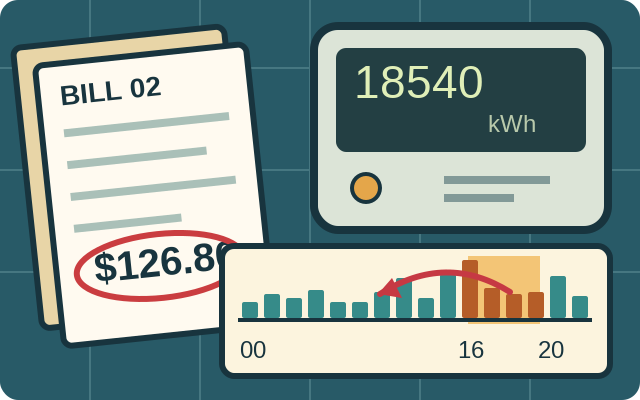
Electric bill game: Electric bill game: move appliance blocks, compare two honest bills, and find what raised the cost.
How to read an electric bill, line by line
- Billing dates. Both periods in the sample are 30 days. A longer period can raise the total even if daily use stays the same.
- Meter readings. Subtract the opening reading from the closing reading. The result is the energy used, measured in kilowatt-hours (kWh).
- Rates. Identify the published tariff. The fictional Lantern Circuit practice tariff charges $0.16 per kWh outside 16:00–20:00 and $0.36 inside that window, every day.
- Energy charges. Multiply each band’s kWh by its own rate. For the sample, the extra 60 peak kWh cost 60 × ($0.36 − $0.16) = $12.00 more.
- Other lines. Look for fees, credits and taxes. Here only the $14.00 fixed fee remains; real bills can have more lines. Add the energy charges and fixed fee to reconcile the total.
Use the buttons above to move the dishwasher’s two-hour block. Both actual bills remain frozen; the third column shows a hypothetical next period with the same amount of energy. No energy is removed by changing its start time. Count the hours in the 16:00–20:00 window for each possible start (20:00 itself is off-peak). In a household with a one-change limit, compare each job’s peak kWh savings before choosing which to move; a job that already runs outside peak can stay where it is.
For an actual bill, the supplier's own rate schedule and bill guide define its hours, prices and charge types. This is not an estimate for any real utility or home.
Questions people ask
What is a kWh?
A kilowatt-hour measures energy. A device using one kilowatt of power for one hour uses one kWh.
Can the same kWh cost a different amount?
Yes, under a time-of-use tariff the unit price can depend on when the energy is used. The actual schedule and prices depend on the supplier and plan.
Does moving appliances remove the fixed fee?
Not in this example. The fixed fee is billed each 30-day period regardless of the amount or timing of use.
Are these my supplier's rates?
No. Lantern Circuit is a fictional practice tariff, with only two energy prices and a service fee. Actual bills may include delivery, generation, tax, credits and other lines.
Where this comes from
- Redwood Coast Energy Authority: Residential time-of-use bill explainer (PDF)
- U.S. Energy Information Administration: Measuring electricity
- North Carolina Public Staff: Understanding your electric bill
- U.S. Department of Energy: Evaluating your utility rate options
- U.S. Department of Energy: Federal demand flexibility
Last changed . Rules change, and states add their own: check the source before you act on one. Found a mistake? How we check, and how to tell us.
Go on
See also financial literacy games and consumer math games and life skills games.