Logical fallacies list: 28 types with definitions and examples
28 logical fallacies in plain words. The list has a definition, an everyday example and something to answer for each, and a short drill.
Each with its definition, an example and an answer to give.
Off the point
They answer something else than what was said.
Ad hominem
Also: attacking the person
- Definition
- Attacking the person who says something instead of what they say.
- Example
- “Don't listen to her about the leak. She wears socks with sandals.” Her feet tell us nothing about the pipe.
- How to answer:
- “Say all of that is true about me. Is the point right or wrong?”
- When it is fine:
- It is fair when the question is whether a person can be trusted, such as a witness or a seller.
Straw man
Also: straw person, strawman
- Definition
- Swapping what somebody said for a weaker version, and knocking that down.
- Example
- “She asked for one evening without TV. So she wants us to stare at the wall for the rest of our lives.” One evening was asked for. The rest was added, so that it is easier to beat.
- How to answer:
- “That is not what I said. What I said is …”
- When it is fine:
- Saying it back is fair when you ask: “Do I get you right?”
Red herring
Also: changing the subject
- Definition
- Bringing up something else, so that the real question gets lost.
- Example
- “You ask who broke the window. Why does nobody ever talk about how well I throw?” The question was the window.
- How to answer:
- “Good topic, later. What about my question?”
- When it is fine:
- A second topic is fine when it changes the answer to the first.
Tu quoque
Also: whataboutism, “you too”
- Definition
- Answering a criticism with “you do it too” instead of an answer.
- Example
- “You tell me to go to bed early? You were up until two on Saturday.” That they were up late does not make it a good idea.
- How to answer:
- “Maybe I do. Is it a good idea all the same?”
- When it is fine:
- Pointing at somebody's own acts is fair when they claimed never to do it.
Appeal to emotion
Also: appeal to pity, appeal to fear
- Definition
- Using pity, fear, guilt or flattery where a reason should be.
- Example
- “My hamster ran away on Tuesday. So I should get an A on this test.” Poor hamster. But the grade is about the test.
- How to answer:
- “I feel that too. What speaks for it besides the feeling?”
- When it is fine:
- Feelings count when they are what the question is about.
Borrowed weight
They lean on a name, a crowd or a word instead of a reason.
Appeal to popularity
Also: bandwagon, ad populum
- Definition
- Calling something true or good because many people believe it or do it.
- Example
- “Two thousand people stood in line for these donuts. They must be the best in the country.” A line shows that many came. It does not show how anything tastes.
- How to answer:
- “Many do. Why do they?”
- When it is fine:
- Counting people is right when the question is what people want.
Appeal to nature
In short: natural, so good
- Definition
- Calling something good because it is natural, or bad because it is not.
- Example
- “It's made from plants, so you can take as much as you like.” Some plants are poison. “Natural” does not say how much is safe.
- How to answer:
- “Natural is where it comes from. What does it do?”
- When it is fine:
- It is fair to talk about a plant or a material when a property of it is the reason.
Appeal to tradition
In short: always done it
- Definition
- Calling something right because it has always been done that way.
- Example
- “We have always parked on the lawn. So that's what a lawn is for.” How long it was done does not make it a good place for a car.
- How to answer:
- “What was the reason when it started? Is it still there?”
- When it is fine:
- An old habit is worth keeping when the reason behind it still holds.
Appeal to novelty
In short: new, so better
- Definition
- Calling something better because it is new.
- Example
- “Version 8 worked fine. But 9 is newer, so 9 is better.” Nine is a number. What does it do?
- How to answer:
- “What can it do that the old one cannot?”
- When it is fine:
- New is a reason when you can say what got better.
Thin proof
There is some evidence, and it is not enough for what is claimed.
Hasty generalization
In short: too few cases
- Definition
- Making a rule about all of them from too few of them.
- Example
- “Two taxi drivers were rude to me. What a rude town!” Two drivers are not a town.
- How to answer:
- “How many did you look at?”
- When it is fine:
- A rule from a sample is fine when the sample is large and was not picked by hand.
Anecdotal evidence
Also: one story
- Definition
- Setting one personal story against evidence from many cases.
- Example
- “Eight of ten testers say that the tent leaks. Mine stayed dry one night, so they're wrong.” One dry night against eight testers.
- How to answer:
- “I believe you. What happened to the others?”
- When it is fine:
- One case is enough to show that something can happen, or that “never” is wrong.
Cherry picking
Also: suppressed evidence
- Definition
- Showing the evidence that fits and leaving out the rest.
- Example
- “The weather app is always right. I write it down every time that it is.” The times when it is wrong were never written down.
- How to answer:
- “Can I see all of them?”
- When it is fine:
- Showing a few is fine when they were not chosen for how they turned out.
Burden of proof
Also: appeal to ignorance
- Definition
- Making a claim and telling others to disprove it, as if “not disproved” meant “true”.
- Example
- “There's a ghost in our attic. Nobody has ever shown that there isn't.” Who says ghost has to show ghost.
- How to answer:
- “You said it, so you show it.”
- When it is fine:
- Asking for proof is fair when you ask the one who made the claim.
Cause and chance
They see a cause, a chain or a debt where there is none.
Post hoc
Also: false cause
- Definition
- Claiming that one thing caused another only because it came first.
- Example
- “I washed the car, and an hour later it rained. I have got to stop doing that.” The rain came after the wash. Nothing shows that the wash brought it.
- How to answer:
- “What else happened before it?”
- When it is fine:
- It is fair when it was tried again, with and without, and came out the same.
Correlation as cause
Also: cum hoc
- Definition
- Claiming that one thing causes another only because they go together.
- Example
- “Kids with bigger feet read better. So let's buy them bigger shoes.” Older kids have bigger feet, and have been in school longer.
- How to answer:
- “Could something else cause both?”
- When it is fine:
- It is fair when people or things were put into two groups by lot and only one thing was changed.
Slippery slope
In short: one step, then ruin
- Definition
- Claiming that one small step ends in ruin, without showing that each step follows.
- Example
- “Lend him a pen and next he wants your stapler. By Friday he lives in your garage.” Nothing makes a pen lead to a garage.
- How to answer:
- “Which step makes the next one happen?”
- When it is fine:
- A chain is fair when there is a reason for each link.
Gambler's fallacy
In short: luck is due
- Definition
- Believing that luck has to even out: that past results change the next one when each is separate.
- Example
- “Heads five times in a row. The next one has to be tails.” The coin does not remember. It is fifty-fifty again.
- How to answer:
- “How would it know what came before?”
- When it is fine:
- It is fair when things are not put back: each card that is out changes what is left.
Sunk cost fallacy
In short: too late to stop
- Definition
- Going on because of what is already spent, not because of what is still to come.
- Example
- “This movie is awful. But I paid $14 for it, so I'm staying until the end.” The money is gone. The next hour is not.
- How to answer:
- “That part is gone either way. From here on, is it worth it?”
- When it is fine:
- Going on is right when what is still to pay is less than what it will bring.
Rigged frame
The choice, the question or the words are set up so that only one answer is left.
False dilemma
Also: false dichotomy, either/or, black or white
- Definition
- Offering too few choices, usually two, when there are more.
- Example
- “You're either a cat person or you have no heart.” Dog people, fish people and people with allergies have hearts too.
- How to answer:
- “What else could we do?”
- When it is fine:
- Two choices are fine when there really are only two.
Loaded question
Also: complex question
- Definition
- Asking in a way that takes something unproved for granted.
- Example
- “Have you stopped cheating at cards?” Yes or no, both admit to cheating.
- How to answer:
- “Your question says that I did. I did not.”
- When it is fine:
- A question may build on what the other one has already said.
Circular reasoning
Also: begging the question
- Definition
- Giving the claim itself, in other words, as its own reason.
- Example
- “You can trust me, because I never lie. And I must know, I just told you.” Only somebody who already trusts the speaker can use that reason.
- How to answer:
- “That is the same thing twice. Why do you think so?”
- When it is fine:
- A definition may say a word again in other words. It explains, and it does not try to prove.
No true Scotsman
In short: the exception is out
- Definition
- Saving a rule from an exception by changing who counts.
- Example
- “Nobody on Maple Street locks the door.” “I live there and I lock mine.” “Then you're not really from Maple Street.” The rule met an exception, so the exception was thrown out.
- How to answer:
- “Who counts? Please say so before I name another one.”
- When it is fine:
- Saying “that is not one” is fair when the meaning was fixed before.
Moving the goalposts
In short: a new demand every time
- Definition
- Asking for more each time what was asked for has been shown.
- Example
- “I said you can go when your room is clean. It's clean? Well, now the garage too.” The room was the deal. It was kept, and then the deal was changed.
- How to answer:
- “That is what you asked for. Is there anything else, and is it the last thing?”
- When it is fine:
- Holding on to a demand that was made at the start is fair.
Middle ground
Also: argument to moderation
- Definition
- Calling something right because it lies between two others.
- Example
- “You say we owe $40, he says $80. So it's $60, that's only fair.” The middle of two guesses is still a guess. What was spent is the bill.
- How to answer:
- “One of them may simply be right. Let's look.”
- When it is fine:
- Meeting in the middle is fine when it is about wishes, not about facts.
False equivalence
Also: weak analogy
- Definition
- Treating two things as equal although they differ in what matters.
- Example
- “You crashed my car and I was two minutes late. So we're even.” Both are annoying. Only one of them needs a body shop.
- How to answer:
- “They are alike in one way. Is it the way that matters?”
- When it is fine:
- A comparison holds when the two are alike in what matters.
Composition or division
In short: part and whole mixed
- Definition
- Thinking that what is true of the parts is true of the whole, or the other way around.
- Example
- “I like mint, I like gravy, I like ice cream. So I'll love mint gravy ice cream.” Good parts do not have to make a good whole.
- How to answer:
- “One by one, yes. And all together?”
- When it is fine:
- From part to whole is fine for what adds up, such as weight.
The people, shops and places are made up. The names follow the sources below, and scholars draw some of the lines differently.
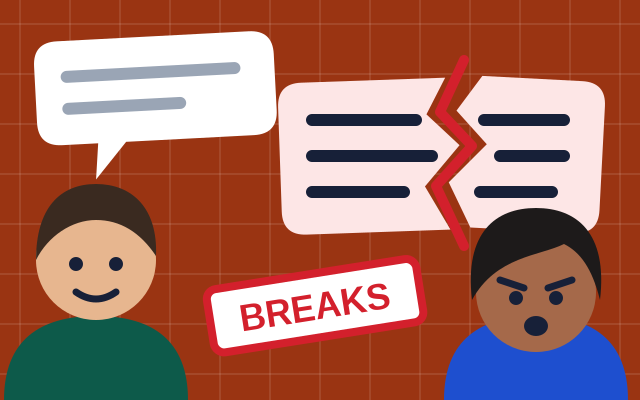
Now find the traps yourself
Logical fallacies game: People argue at dinner, in chats and in reviews. Press the line that is no reason at all, and stamp the fallacy with its name.
Formal and informal
A formal fallacy is broken by its shape alone, whatever it talks about. An informal one depends on what is said: you have to look at the reason and ask whether it supports the claim. All the types in this list are informal. They are the ones one meets in talk, in ads and in articles.
There is no official list. The Internet Encyclopedia of Philosophy names 231 and says that researchers disagree about which names are the most useful. These 28 were chosen because one can meet each of them in an ordinary week.
Two names for one sentence
The names overlap. “You do it too” is also a kind of attack on the person. One story is also a very small sample. A false dilemma often comes with a good helping of fear. So do not argue about the label. Say what is missing: the third choice, the other cases, the real words.
Using a name without being rude
Whoever says “fallacy” has to show it. That is why every entry has an answer to give instead of a label, and a line on when the same move is fine. A real expert on the subject is good evidence. A chain of steps is fine when each link has a reason. And a claim can be true although the reason given for it is bad.
Questions people ask
How many logical fallacies are there?
There is no agreed number. Aristotle listed thirteen. The Internet Encyclopedia of Philosophy lists 231 names today. This list has the 28 that turn up most easily in everyday talk and ads.
What is the difference between a formal and an informal fallacy?
A formal fallacy can be seen from the form of the argument alone. An informal one depends on what is said, so you have to look at the content. All types in this list are informal.
What is the difference between a straw man and a red herring?
A straw man still talks about the other side's position, but about a twisted version of it. A red herring leaves the position alone and changes the subject.
Is an appeal to authority always a fallacy?
No. Most of what we know comes from people who know more than we do. It goes wrong when the person is no expert on this subject, cannot be trusted on it, or when the experts disagree.
Where this comes from
- Internet Encyclopedia of Philosophy: Fallacies
- Stanford Encyclopedia of Philosophy: Fallacies
- The Writing Center, University of North Carolina: Fallacies
- Purdue Online Writing Lab: Logical fallacies
- OpenStax, Introduction to Philosophy: Informal fallacies
- Jarrette and Daly, Decoding Deception (University of Arizona): False equivalences
- Owen M. Williamson, University of Texas at El Paso: Master list of logical fallacies
Last changed . Rules change, and states add their own: check the source before you act on one. Found a mistake? How we check, and how to tell us.