Quillmont Logistics
Human resources, 140 employees
Separation agreement and release
November 20- Employee
- Victor Hale, 46
- Hired
- October 2016
- Last day
- December 11
This severance agreement is an example with an invented company. Press a line to read what it means, what is yours in any case, and how long one may think.
Press any line to read what it means.
Your age
Let go
Press what fits. The days are those of the federal age law.
For employers with 20 or more employees, when the agreement asks to give up age discrimination claims.
The offers are made up, and the rules are federal unless a state is named, as of the date below. This is not advice about your own offer.
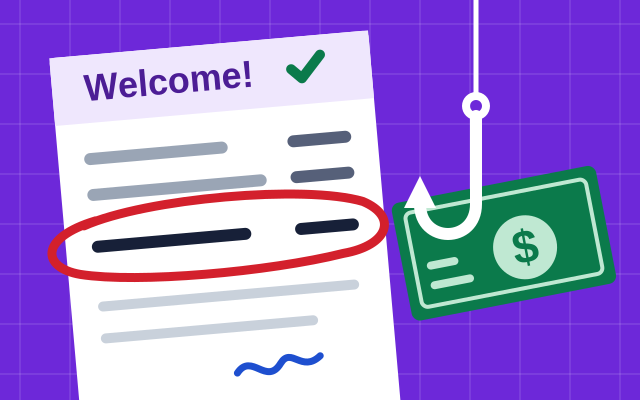
Job offer game: The recruiter wrote one thing, the job offer says another. Find the lines that changed, before somebody signs them.
A severance agreement, also called a separation agreement, is a contract. The company gives something it does not owe: weeks of pay, months of health insurance. The employee gives a release, which means giving up claims. Federal wage law does not require severance pay. It comes from a policy, a contract or a negotiation.
The first thing to do is arithmetic. Take out what is owed anyway: pay to the last day, and earned vacation where the policy or the state says it is paid. The rest is what is offered for the signature.
| Can it be given up? | |
|---|---|
| Discrimination claims from the past | Yes, if it is knowing and voluntary, and something of value is given for it |
| Filing a charge with the EEOC | No. A clause against it is not enforceable |
| Helping an EEOC investigation | No |
| Age claims that arise after signing | No |
| Age claims of people of 40 and over | Only with the conditions of the law: 21 or 45 days, 7 days to revoke, advice in writing to see an attorney, plain words |
Whoever files a charge with the EEOC does not have to give the severance back first. The agency's checklist for employees also says to make sure that the paper does not release unemployment benefits, workers' compensation, claims for minimum wage or overtime, COBRA coverage, or vested retirement benefits. It calls being rushed a red flag, and says to ask for more time in writing.
No. It is an offer: something of value for a release of claims. Without a signature there is usually no severance, but pay that has been earned is owed anyway.
People of 40 and over, at employers with 20 or more employees, when the agreement asks them to give up age discrimination claims. It is at least 21 days for one person, and at least 45 when a group is let go together. After signing there are 7 days to revoke.
The federal wage law, the Fair Labor Standards Act, does not. Severance is a matter of agreement between the employer and the employee, or of the company's own plan.
Yes. No agreement can keep you from filing a charge with the Equal Employment Opportunity Commission or from helping its investigation, and you do not have to return the severance before you file.
After a job ends, as a rule 18 months, with at least 60 days to choose it. It is for plans of employers with 20 or more employees, and can cost up to 102% of what the plan costs.
Last changed . Rules change, and states add their own: check the source before you act on one. Found a mistake? How we check, and how to tell us.
See also financial literacy games and life skills games.