Closing Disclosure example, next to the Loan Estimate
This Closing Disclosure example belongs to the loan of our Loan Estimate example. Compare them: both numbers stand side by side, and every line says whether the change is allowed.
Press any line to read what it means.
Page 2, next to the Loan Estimate, line by line
- 0.25% of Loan Amount (Points), $620.00
- The rate was locked, so the points stay too.
- Application Fee, $300.00
- The lender's own charge. The same on both papers, as it has to be.
- Underwriting Fee, $1,095.00
- The lender's own charge. The same on both papers, as it has to be.
- Appraisal Fee, $575.00
- You could not shop for it, so it may not be higher.
- Credit Report Fee, $65.00
- You could not shop for it, so it may not be higher.
- Pest Inspection Fee, $135.00
- Taken from the lender's list, so it stands in section B now.
- Title – Lender's Title Policy, $620.00
- From a company on the list. Section B of the Closing Disclosure is for services you did not shop for.
- Title – Settlement Agent Fee, $560.00
- $20 more. It is one of the 10% group, and only the sum of the group counts.
- Title – Title Search, $790.00
- $30 more. It is one of the 10% group, and only the sum of the group counts.
- Survey Fee, $525.00
- This buyer found a surveyor who is not on the list. Such a charge may change by any amount.
- Recording Fees and Other Taxes, $148.00
- $8 more. Recording fees belong to the 10% group.
- Transfer Taxes, $1,240.00
- Transfer taxes may not be higher than estimated.
- Homeowner's Insurance Premium (12 mo.), $1,584.00
- $60 more. The insurance company sets it, and it may change by any amount.
- Prepaid Interest ($44.78 per day for 11 days @ 6.5%), $492.58
- The same number of days. The Loan Estimate rounds to dollars, the Closing Disclosure shows cents.
- Homeowner's Insurance, 2 months, $264.00
- It moves with the insurance premium: $132 a month instead of $127.
- Property Taxes, 3 months, $975.00
- No change.
- Title – Owner's Title Policy (optional), $560.00
- No change.
- D. Total Loan Costs, $5,285.00
- $2,015.00 + $2,745.00 + $525.00. Four services from the lender's list have moved from C to B; the sum is what you compare.
- I. Total Other Costs, $5,263.58
- $1,388.00 + $2,076.58 + $1,239.00 + $560.00.
- J. Total Closing Costs, $10,548.58
- $172.58 more than estimated, and every dollar of it may be: the 10% group rose by $58.00 on $2,195.00, the rest is insurance, escrow and a surveyor the buyer found.
Page 1: compare with the Loan Estimate
Page 1: compare with the Loan Estimate, line by line
- Loan Amount, $248,000
- It has to be the loan you asked for. If it is higher, ask whether costs were added to it.
- Interest Rate, 6.5%
- It was locked and the closing is in time, so it is the same.
- Monthly Principal & Interest, $1,567.53
- The same loan, the same rate, the same payment.
- Prepayment Penalty, NO
- If a penalty is added after you got this paper, you get a new one and three more business days.
- Estimated Escrow, $457.00
- Five dollars more a month, because the insurance costs $60 more a year.
- Estimated Total Monthly Payment, $2,024.53
- $1,567.53 and $457.00. Taxes and insurance can move it every year.
Page 3: calculating cash to close
Page 3: calculating cash to close, line by line
- Total Closing Costs (J), $10,548.58
- This table shows the Loan Estimate and the final number side by side. If charges rose by more than the limits allow, this line has to say by how much.
- Closing Costs Paid Before Closing, $0
- Closing costs you have paid already, for example a credit report fee. Here there are none.
- Closing Costs Financed, $0
- Costs added to the loan instead of paid now. If there is a number here, your loan amount is higher than you may think.
- Down Payment/Funds from Borrower, $62,000.00
- Price less loan.
- Deposit, – $6,000.00
- The deposit of the contract. If it is missing, you pay it twice.
- Seller Credits, – $2,500.00
- What the seller agreed to pay. Compare with the contract.
- Cash to Close, $64,048.58
- What you bring, usually by wire or cashier's check: $10,548.58 + $62,000.00 – $6,000.00 – $2,500.00.
The people, lenders and numbers are made up, and the rules are the federal ones as of the date below. This is not advice about your own loan.
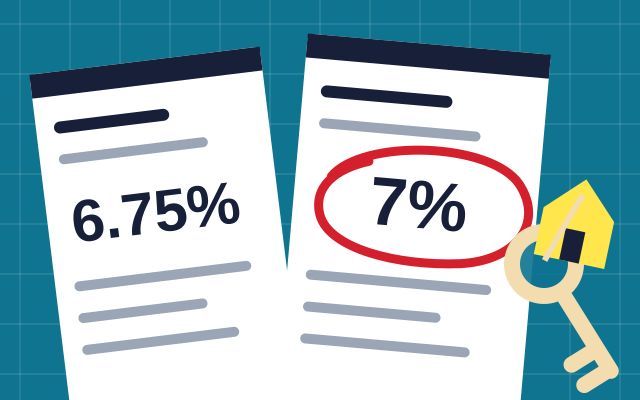
Now find the traps yourself
Home buying game: The mortgage papers say one thing in October and another at the closing. Find what changed, and what was not allowed to.
Closing Disclosure: when is three days before?
Type the day of the closing. The calendar does the rest, with Sundays and holidays.
Every day counts as a business day here, Saturdays too, except Sundays and the federal legal holidays.
Last day to have the Closing Disclosure in your hands:
Saturday, December 12, 2026
Counted back: Tuesday, Monday, Saturday. Not counted: Sunday.
Not handed over in person? Then it counts as received three business days after it was sent, unless the lender can show that you had it sooner. Sent by Wednesday, December 9, 2026, it is in time.
Check your own two papers
Four sums from your Loan Estimate and your Closing Disclosure. Nothing you type leaves this page.
- First group: above the estimate
- $0.00
- Second group: limit with 10%
- $2,414.50
- Second group: above the limit
- $0.00
- To ask about
- $0.00
Both groups are within their limits.
Lender credits that got smaller count as a charge that went up: the difference belongs in the first group.
What the Closing Disclosure is
Five pages with the final terms of the loan, the fees and the cash to close. You must have it at least three business days before you sign. The days are there for one thing: to compare it with your Loan Estimate and to ask.
- Page 1: the loan and the monthly payment. Both have to be the ones you agreed to.
- Page 2: every charge, and who gets it. “Services Borrower Did Not Shop For” also has the companies you took from the lender's list.
- Page 3: a table “Calculating Cash to Close”, with the Loan Estimate, the final number and “Did this change?”.
- Pages 4 and 5: escrow, late payments, total of payments, APR, and whom to call.
Three changes start the three days again
Under Regulation Z three changes bring a new Closing Disclosure and three more business days: the APR becomes inaccurate by the rule's measure, the loan product changes, for example from fixed to adjustable, or a prepayment penalty is added. Other corrections can be made up to the closing.
When fees are higher than on the Loan Estimate
Some may be, some may not: the three groups are marked on the example above when you press “How much may it go up?”. If a charge is above its limit and nothing about you, the loan or the home has changed, the part above the limit has to be refunded. The lender can do that at the closing or within 60 days after it, with a corrected Closing Disclosure.
Before you wire the cash to close
An email with new wiring instructions, days before the closing, is the last trap. The CFPB says to write down the phone numbers of your agent early, and to confirm every payment with them, never with a number from the email.
Questions people ask
What is the 3 day rule of the Closing Disclosure?
You must receive the Closing Disclosure at least three business days before you sign the loan. Business days here are all days except Sundays and federal legal holidays, so a Saturday counts.
What starts the three days again?
Three changes: the APR becomes inaccurate by the rule's measure, the loan product changes, or a prepayment penalty is added. Other changes need a corrected paper, at the closing at the latest, but no new wait.
What is cash to close?
What you have to bring to the closing: closing costs plus down payment, less your deposit, less what the seller pays, and with other adjustments. It is worked out on page 3.
What if a fee is higher than it may be?
Ask the lender which change explains it. Without one, the amount above the limit has to be refunded, at the closing or within 60 days after it.
Do I have to sign at the closing?
The CFPB says you do not have to sign anything unless you are satisfied with the terms. If you are buying, you likely have a contract with the seller, and backing out can cost the deposit, so ask for corrections first.
Where this comes from
- CFPB: Closing Disclosure explainer
- CFPB: Can my final mortgage costs increase from what was on my Loan Estimate?
- Regulation Z, 12 CFR 1026.19(e) and (f)
- CFPB: At the closing, do I have to sign if I don't like the terms?
- Business day, 12 CFR 1026.2(a)(6)
- Legal public holidays, 5 U.S.C. 6103
- CFPB: Beware of mortgage closing scams (PDF)
Last changed . Rules change, and states add their own: check the source before you act on one. Found a mistake? How we check, and how to tell us.
More about home loan
- Loan Estimate exampleAll three pages. Press a line to read it, and see how much each charge may go up.
- Mortgage points calculatorWhat the points cost, what they save a month, and the month in which they have paid for themselves.
- PMI calculatorThe month you may ask to remove it, the month it ends by itself, and what lies between.
See also financial literacy games and life skills games.